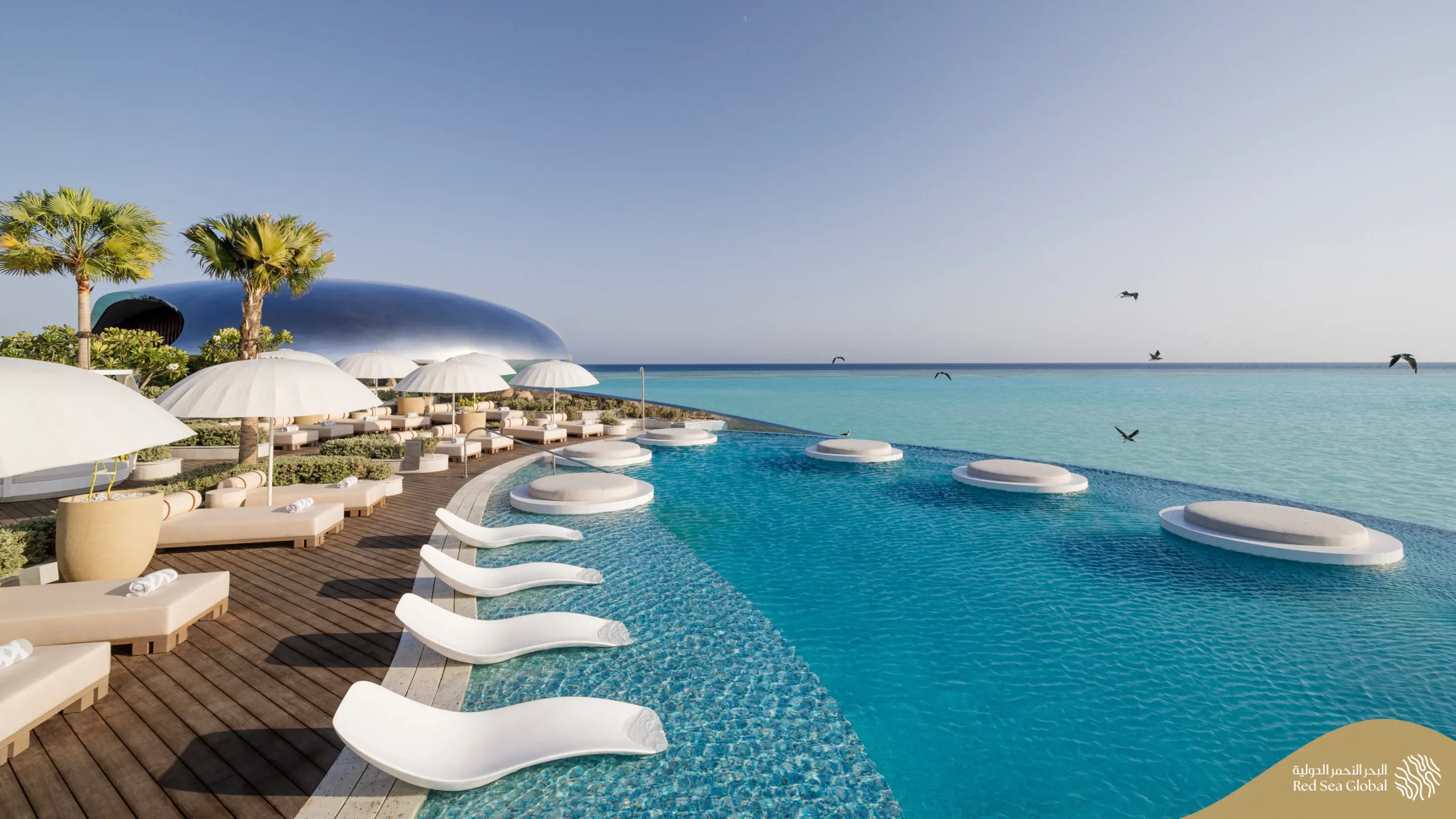
On the island of Shura, Six Senses Southern Dunes is welcoming its first guests in conspicuous silence. No loud marketing campaigns. No major press conferences. Just a wooden gate opening onto 36 villas scattered across the sands of northwestern Saudi Arabia’s desert, where a new operational model for Arabian luxury faces its first serious test.
The Saudi Red Sea Project 2026 represents a pioneering step toward the future of tourism in the region.
The Saudi Red Sea Project 2026 is a global focal point in luxury tourism.
Kilometers away, cranes continue working over 22 of the remaining 90 islands, in what stands as the largest tourism project currently under development in the world. With a declared budget exceeding $30 billion from Saudi Arabia’s Public Investment Fund and an area equivalent to Belgium, Red Sea Global aims to redefine what luxury tourism means in the 21st century — particularly with the focus on the Saudi Red Sea Project 2026.
Yet seven years after the original announcement in 2017, the most pressing question is: where do we actually stand against the plan, and how many of those promises are deliverable within the declared timeline?
In the context of the Saudi Red Sea Project 2026, an integrated infrastructure is being developed.
The Saudi Red Sea Project 2026 seeks to establish new quality benchmarks.
The visions of the Saudi Red Sea Project 2026 align with global tourism trends.
Projects under the Saudi Red Sea Project 2026 initiative require strategic partnerships.
As projects multiply, the Saudi Red Sea Project 2026 emerges as a primary destination.
A Business Model Without Regional Precedent
The Saudi Red Sea Project 2026 represents a defining milestone in global tourism.
The Saudi Red Sea Project 2026 will be an inflection point in the history of tourism.
The guest experience at the Saudi Red Sea Project 2026 will undoubtedly be unique.
All experiences within the Saudi Red Sea Project 2026 will contribute to advancing tourism.
The portfolio of projects under the Saudi Red Sea Project 2026 is expanding rapidly.
The phases of the Saudi Red Sea Project 2026 will be capable of attracting tourists.
What distinguishes Red Sea Global is not scale alone, but its unique legal and economic structure. The company — established entirely under the Public Investment Fund — departs fundamentally from the conventional development model. It is not a real estate firm selling land, nor a hotel operator managing facilities. It is developer, owner, operator, and master regulator of the entire destination: from airport to roads, from infrastructure to hotels, from renewable energy to water.
The environmental challenges associated with the Saudi Red Sea Project 2026 require particular attention.
The Saudi Red Sea Project 2026 reflects a broader vision for the future of tourism.
This model bears some resemblance to Disney’s development of Orlando in the 1960s, or to NEOM in its ambition. But it differs in its exclusive focus on luxury tourism and in the scale of direct public investment.
Within the Saudi Red Sea Project 2026, every experience carries added value.
The Saudi Red Sea Project 2026 will be capable of delivering exceptional experiences.
The Saudi Red Sea Project 2026 is regarded as an opportunity for smart investment.
Saudi Red Sea Project 2026 initiatives aim to meet tourist expectations.
The signature events of the Saudi Red Sea Project 2026 will be watched closely by the world.
The financial model rests on three pillars. The first is long-term government investment, with PIF deploying capital across multiple phases against a return horizon exceeding 15 years. That extended horizon frees the project from the short-term return pressures that constrain conventional developers.
The second pillar is operational partnerships with global brands. Rather than building a local hotel brand, the project has attracted the most prestigious names in luxury tourism: Six Senses, St. Regis, Edition, Nujuma, Fairmont, Raffles, and Faena. These partnerships compress years of trust-building in international markets.
The Saudi Red Sea Project 2026 is considered a unique experience in eco-tourism.
The Saudi Red Sea Project 2026 represents collaboration across different cultures.
Through the Saudi Red Sea Project 2026, a balance between development and environmental preservation is being achieved.
The Saudi Red Sea Project 2026 embodies a national vision for sustainable tourism.
A focus on community engagement is a core element of the Saudi Red Sea Project 2026.
The logistical preparations for the Saudi Red Sea Project 2026 require careful planning.
The third pillar is a diversified revenue model that draws not only from hotels but from the sale of private villas, Branded Residences, cruises, entertainment activities, and cultural experiences. This diversification reduces operational risk and broadens revenue channels.
The Saudi Red Sea Project 2026 should be viewed as an opportunity for positive change.
What Has Actually Been Delivered: A Sober Checklist
In 2026, it is both fair and necessary to conduct an objective review of what has actually opened against what was announced.
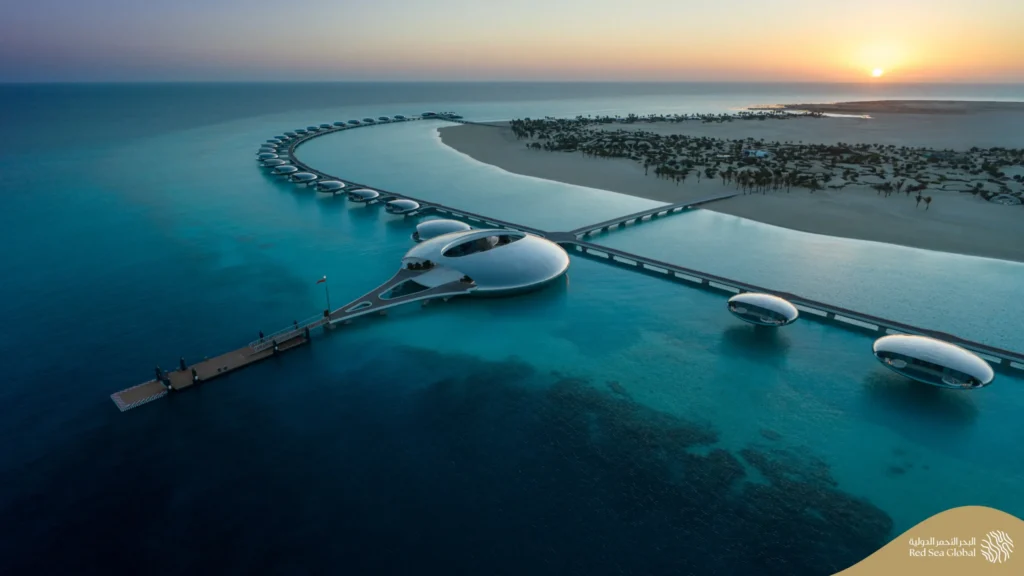
Facilities that have opened and commenced operations include: Red Sea International Airport, inaugurated in 2023 and now receiving limited commercial flights; Six Senses Southern Dunes, which opened in 2023 as the project’s first operational hotel; St. Regis Red Sea, which opened at the end of 2023 on Ummahat Island; Nujuma, part of the Ritz-Carlton Reserve collection, which opened in 2024 on the Umluj archipelago; and Six Senses Amaala at the sister project AMAALA, which began a soft opening.
Several announced projects have, by contrast, been delayed. The Edition hotel was scheduled to open in 2024 and was pushed to 2026. Fairmont Red Sea was delayed from 2024 to 2025. Of the eight Marina Towns announced at launch, only the first phase has been completed.
What remains under construction or in planning includes 22 additional hotels — out of the 50 announced — at varying stages of construction; the Red Sea Yacht Club, still in development; and Shura Island Lagoon, announced as the heart of the destination, which has yet to be completed. The full phase of AMAALA is expected to be completed in 2028.
The total number of rooms actually open by end of 2025 is approximately 1,300 out of the 8,000 announced for Phase One alone — roughly 16 percent of the Phase One target.
The gap between announcement and delivery is not necessarily a failure — it is the natural reality of a project at this scale. The real question is whether that gap will narrow or widen over the next three years.
The gap between announcement and delivery is not necessarily a failure — it is the natural reality of a project at this scale. The real question is whether that gap will narrow or widen over the next three years.
The gap between announcement and delivery is not necessarily a failure — it is the natural reality of a project at this scale. The real question is whether that gap will narrow or widen over the next three years.
Local and international collaboration within the Saudi Red Sea Project 2026 will drive innovation.
The Actual Product: Reading the Guest Experience
What all opened properties share is an exceptional product standard. Reports from early visitors — and assessments by Skift, Travel + Leisure, and Condé Nast Traveler — converge on several key points.
The Saudi Red Sea Project 2026 will have a positive impact on the local economy.
The outlook for the Saudi Red Sea Project 2026 appears highly promising.
The Saudi Red Sea Project 2026 opens the door to further investment in tourism.
The social dimensions of the Saudi Red Sea Project 2026 will be pivotal.
The Saudi Red Sea Project 2026 represents a qualitative leap in the quality of tourism experiences.
On the strengths side, architectural distinction stands out: designs by Foster + Partners, Kengo Kuma, WATG, and Killa Design have created a visually singular experience. On-the-ground execution matches the designs with a precision rarely seen in previous Saudi projects. Privacy levels are notably high — the key-to-acre ratio is deliberately low, creating a sense of seclusion and luxury that crowded Gulf destinations cannot replicate. And the pristine natural environment — turquoise waters, untouched coral reefs, uninhabited islands — offers a natural product that Dubai or Doha simply cannot match.
The product also faces current weaknesses. Entertainment beyond the resort is limited: unlike Dubai, where guests can step out to restaurants, galleries, and diverse events, Red Sea guests tend to remain within their resort. Access still requires time — a domestic flight from Jeddah or Riyadh, followed by road or sea transfers. The roster of independent fine-dining restaurants remains very limited compared to Dubai or Abu Dhabi. And nightlife is virtually absent — a deliberate strategic choice, but one that defines a specific visitor segment.
Pricing positions the project squarely in the Ultra-Luxury category. Nujuma peak-season nightly rates exceed SAR 12,000 — approximately $3,200. Six Senses Southern Dunes starts from SAR 6,000 for a smaller villa and reaches over SAR 50,000 for larger ones. These rates compete directly with luxury Maldivian resorts, properties in Seychelles and Mauritius, and Ritz-Carlton Reserve hotels globally.
Competition with UAE Luxury Destinations
Many analysts ask whether the Red Sea project will hurt Dubai and Abu Dhabi. The realistic answer: yes and no, depending on the segment.
Segments that will be affected include the luxury traveler seeking a combination of beach, privacy, and pristine nature — a profile that historically favored the Maldives, Seychelles, and Mauritius. This segment could partially shift toward the Red Sea, particularly from GCC and Arab markets given geographic proximity and cultural affinity. High-end wellness tourism is another — Six Senses’ global positioning places the Saudi Red Sea on the map for this growing category.
Other segments will not be materially affected. The “City Break Luxury” traveler will continue to favor Dubai and Abu Dhabi for shopping, dining, entertainment, major events, and direct flights from 269 destinations in Dubai’s case. The MICE traveler will find no Red Sea equivalent of Dubai World Trade Centre. And the family tourism segment will remain drawn to experiences like the Louvre Abu Dhabi, Yas Island, and IMG Worlds — offerings the Red Sea’s nature-first concept does not provide.
The more important truth is that the region’s luxury tourism market is growing, not merely being redistributed. Moreover, the Red Sea is attracting segments of American and European travelers who historically never placed Saudi Arabia on their itinerary. This is market expansion, not market diversion.
A revised competitive landscape by 2030 may look as follows: Dubai retains its position as the capital of urban, multifaceted luxury tourism. Abu Dhabi remains the capital of cultural and upscale family tourism. The Red Sea establishes itself as the destination of choice for nature-based luxury and wellness. Ras Al Khaimah captures high-end entertainment tourism through Wynn. And Doha targets cultural and sports tourism. Each destination occupies its own lane — competition need not be zero-sum.
The Environmental Debate: Between Claims and Verification
Red Sea Global announced ambitious environmental commitments from the outset, making the project a subject of global debate. Those commitments include 100 percent renewable energy use, preservation of 75 percent of islands without development, a 30 percent increase in biodiversity conservation value by 2040, coral reef rehabilitation, and full carbon neutrality for the project’s footprint.
What has actually been achieved deserves acknowledgment. The solar energy plant is the largest renewable energy project for a tourism facility in the region and powers the project’s first phase. A coral reef monitoring program, conducted in partnership with King Abdullah University of Science and Technology (KAUST), tracks environmental changes. Construction operations use methods designed to minimize impact on the surrounding environment. And water treatment and recycling systems reduce overall consumption.
Environmental critics — particularly in reporting by The Guardian, Bloomberg Green, and Wired — have raised substantive questions. First: can the cumulative impact of 50 hotels and thousands of annual visitors on pristine coral reefs genuinely be avoided? Second: the use of desalinated water to operate facilities in a desert region consumes enormous energy. Third: the daily movement of staff and guests — with the workforce expected to exceed 35,000 employees at full operation — generates a significant carbon footprint. Fourth: the infrastructure construction itself — roads, airport, utilities — left a visible environmental mark on the area in its early years.
The objective reality is that the project does more than the industry average, but less than it sometimes claims in its marketing materials. The assertion that impact-free luxury tourism is achievable remains a claim requiring long-term proof — one that cannot be properly assessed before 10 years of full operation.
Strategic Challenges Facing the Project
Beyond the gloss, the project faces genuine challenges that must be placed on the table.
The first is the challenge of filling hotels. Opening a luxury hotel is straightforward; sustaining occupancy at 70 percent or above in a greenfield destination is considerably harder. New luxury destinations typically require 5 to 7 years to reach sustainable occupancy levels. The challenge is compounded by the fact that the project is opening multiple hotels simultaneously.
The second is air connectivity. Red Sea International Airport currently serves a limited number of routes. Access from major source markets — London, New York, Paris — requires a connection through Riyadh, Jeddah, or Dubai, adding complexity and cost to a journey that should ideally be seamless and direct.
The third is human capital. Operating 50 luxury hotels requires tens of thousands of trained personnel. Saudi Arabia is investing in broad training programs through the Saudi Tourism Academy, but building a domestic talent base for the sector takes time. Dependence on expatriate staff in the early phases creates challenges for the localization of employment.
The fourth is tourism behavior. A guest at a luxury Maldivian resort arrives with specific expectations. The Red Sea offers a different product — one defined by greater tranquility and conservative activity options. Educating the global market about the nature and value of the Saudi product will require years of sophisticated marketing effort.
The fifth is market absorption capacity. Analysts ask: does the world need 50 additional luxury hotels in a single location? The global Ultra-Luxury hospitality market is finite in size. Rapid expansion risks oversupply if it is not matched by commensurate demand growth.
Outlook to 2027
Three plausible scenarios for the Red Sea project by 2027.
The first — and most probable — is controlled execution. This involves the opening of 8 to 12 additional hotels by end of 2027, reaching 3,500 to 4,000 operational keys. Average occupancy settles between 55 and 60 percent — acceptable for an emerging destination. Intensive promotion begins through partnerships with specialist tour operators and a number of global DMCs. Delays are contained and overall momentum improves.
The second scenario is institutional acceleration: restructuring of operational management to fast-track openings; new strategic partnerships with international operators; a major marketing campaign timed to coincide with Riyadh Season 2027; reaching 5,000 or more operational keys with occupancy between 65 and 70 percent. This scenario is achievable but requires a clear strategic decision from senior leadership.
The third scenario is further delays: postponements affecting 4 to 5 announced openings; a revision of the Phase One timeline from 2030 to 2032; and a greater emphasis on the quality of opened properties over quantity. This scenario is not inherently negative — it may in fact represent a strategically sound approach to avoiding oversupply.
The most likely outcome: a blend of scenarios one and three — phased openings with flexibility built into the timeline.
What Comes Next
The Saudi Red Sea project is more than a tourism development. It is a symbol of Saudi Arabia’s economic transformation and a genuine test of the region’s capacity to execute projects to global standards.
What can be stated with confidence in 2026 comes down to four points. The opened product is genuinely world-class — without marketing inflation. The gap between announcement and delivery is real, but it is normal for projects of this scale. The environmental claims are advanced but require long-term verification. And the impact on Dubai and Abu Dhabi will be measured and gradual, because the luxury market is growing — not merely being redistributed.
Three points, by contrast, remain uncertain. The pace of full completion — will it occur by 2030 as announced, or extend to 2033–2035? Sustainable occupancy levels — will the project attract the volume needed to deliver expected returns? And long-term environmental impact — an answer that will not be available before 2035.
What is clear is that Saudi Arabia is writing a new chapter in the history of global luxury tourism. That chapter may become a complete success story, or the story of an ambitious undertaking that delivers half of what it promised — and either outcome is respectable given the scale of the challenge.
The question that 2030 will answer is no longer whether the project will succeed — it has already succeeded in demonstrating that construction to this quality standard is possible. The real question has become: to what degree will Red Sea Global deliver on its declared ambitions, and what will the global tourism industry learn from the experience?