Middle East Travel Intelligence — Analysis
While Middle East tourism contracted 14% in Q1, Saudi domestic tourism grew 16%. That figure does not mean the Kingdom was insulated from the shock — it reveals something deeper: that the domestic demand base built for growth objectives served a function it was never explicitly designed for — absorbing geopolitical shocks.
In a quarter that saw the Middle East record its sharpest tourism contraction in years — a 14% decline according to the UN Tourism Organization — data from the Saudi Ministry of Tourism presented the counterpoint: domestic tourism grew 16% year-on-year in Q1 2026, with roughly 28.9 million domestic visitors. While combined domestic and international arrivals reached approximately 37.2 million, generating total spending of 82.7 billion riyals, a precise reading of these numbers matters more than the headlines describing them as a “safe haven.”
Saudi Arabia was not shielded from the shock. Like the UAE, Qatar, Bahrain, and Oman, it is among the GCC countries that saw a decline in international arrivals due to airspace disruption and the Iran war. What happened is that a substantial domestic engine offset the bulk of the external loss, turning what could have been a catastrophic quarter into a resilient one. That is the real story — and it is, by any measure, a strategic one.
Context: Diversification Designed for Growth That Delivered Protection
Saudi Arabia entered 2026 from a record peak. In 2025, it welcomed approximately 122 million visitors, having surpassed its original target of 100 million arrivals six years ahead of schedule. Riyadh subsequently raised its ambition to 150 million annual visitors by 2030, split between 70 million international and 80 million domestic.
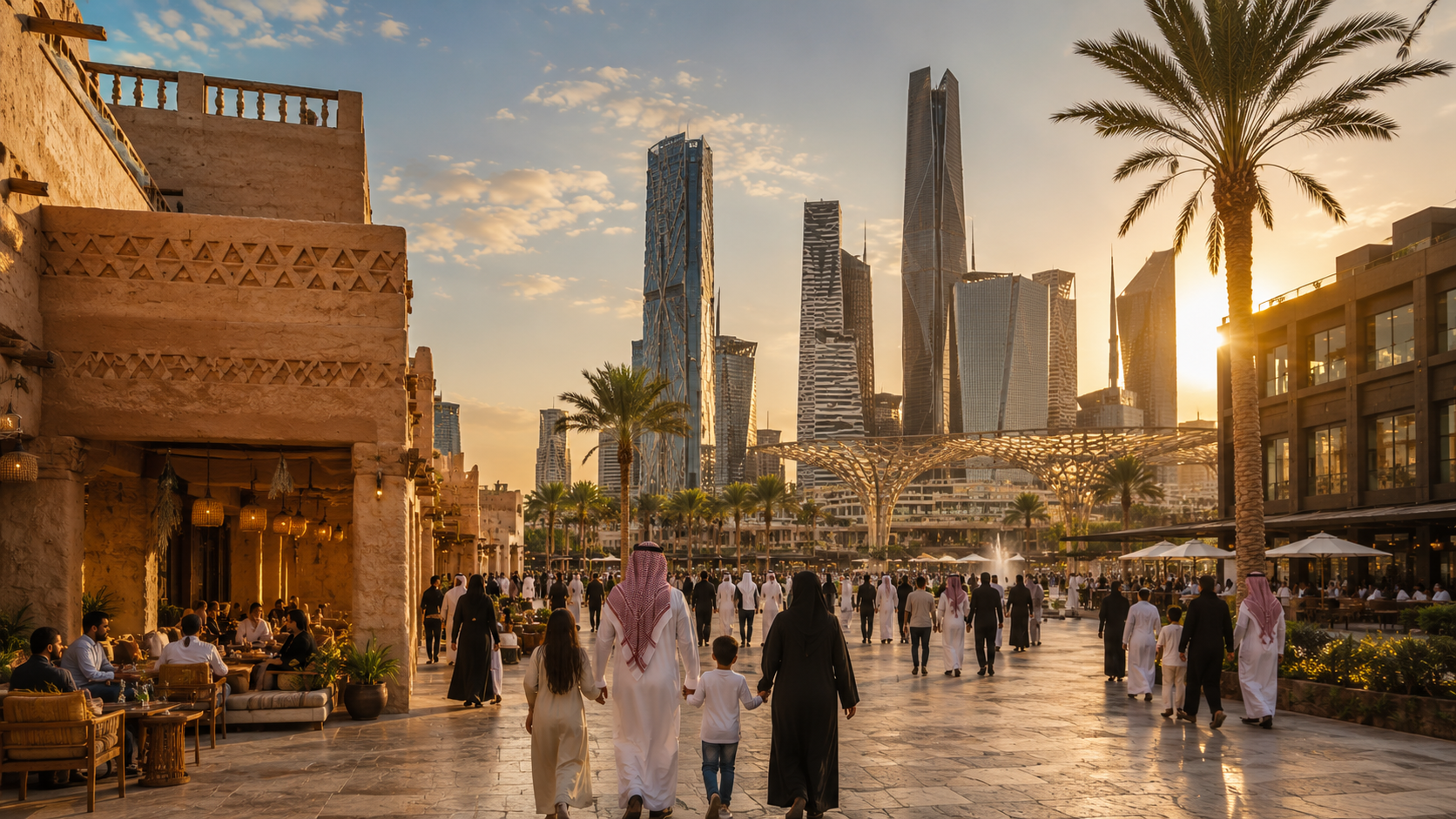
This structure — in which the domestic demand target exceeds the international one — was not originally designed as a defensive mechanism, but as a growth pillar within Vision 2030. Yet in Q1 2026, it served an entirely different function. When international demand contracted across the region due to corridor closures and rising airfare costs, Saudi citizens and residents continued traveling domestically, because their decisions are not tied to transcontinental airspace or international ticket prices. The domestic demand base thus shifted from a growth engine to a shock absorber — precisely the buffer that transit-dependent hubs reliant on long-haul visitors lack.
Analysis: Why Saudi Arabia Held While the Gulf Faltered
The gap between Saudi Arabia and the other Gulf hubs is not explained by economic size — it is explained by demand composition. The model reliant on long-haul leisure demand and international corporate travel — as in Dubai, Abu Dhabi, and Doha — is the most sensitive to any airspace disruption, because those two segments are the first to cancel and defer. Saudi Arabia, by contrast, held a reserve of demand insulated from airspace closures by the depth of its domestic market and the scale of its population.
The granular data reinforces this reading. Alongside the 16% volume growth in domestic tourism, domestic tourism spending rose 8% to 34.7 billion riyals (approximately $9.25 billion). The distinction between the two figures is editorially significant: volume growth (16%) outpaced spending growth (8%), suggesting that part of the domestic travel shift moved toward shorter, lower-cost trips — behavior entirely consistent with an environment of uncertainty, in which travelers shorten distances and calibrate spending without canceling travel altogether.
The second element in the equation is religious tourism, which has proven to be the most resilient of all. The Umrah season continued without interruption even at the peak of the escalation, with approximately 1.68 million international pilgrims arriving despite the disruption. This type of demand is nearly inelastic: its motivation is doctrinal, not recreational, and it does not yield readily to higher prices or security concerns. Saudi Arabia therefore holds two layers of protection unavailable to any other Gulf hub: a large domestic market, and a near-guaranteed religious inflow.
The outcome at the hotel occupancy level was resilient under difficult conditions: average occupancy reached 59% in Q1, led by Madinah at approximately 82%, followed by Makkah at 60% and Jeddah at 59%. These figures clearly reflect that religious and domestic demand carried the weight when international demand retreated.
Industry Implications
For the hospitality sector, the message is that assets tied to religious and domestic demand — Makkah, Madinah, and regional destinations — enjoy a cyclical immunity that outpaces assets reliant on international guests. This repositions developer and investor priorities toward locations that combine growth with durability, not growth alone.
For airlines, a clear bet on continued domestic demand has emerged: flyAdeal launched new domestic routes, and flynass added domestic services at the start of Q2. This expansion of the low-cost domestic network is no coincidence — it is a calculated positioning to capture demand that shifted inward from international markets.
For investors, the Saudi story offers a lesson in risk pricing: diversification across source markets is no longer an operational luxury, but a factor that reduces return volatility across geopolitical cycles. A tourism asset underpinned by deep domestic demand warrants a valuation premium over one dependent on a single international inflow.
For regional governments, the Saudi model raises a direct question: can smaller GCC economies by population build a comparable domestic demand cushion? The answer is likely no — not at the same scale — which points them toward alternatives: deepening intra-Gulf tourism and diversifying international source markets, rather than relying on a single axis.
Outlook
The defining question for the months ahead is how far domestic demand can compensate for prolonged international weakness. The answer hinges on two variables. The first is the trajectory of the conflict itself, which remains fragile; exchanges between Israel and Iran resumed on June 8 for the first time since the April ceasefire, keeping the return of international visitors hostage to a stability that has yet to solidify. The second is the absorption capacity of the domestic market: local demand can cushion a short-term shock, but compensating for a target of 70 million international visitors by 2030 will inevitably require the return of external flows.
Decision-makers should monitor three indicators: the sustainability of domestic tourism growth in Q2 — whether it was a situational rebound or a structural trend — the recovery curve of international arrivals with each improvement in security conditions, and whether Saudi Arabia can convert its enduring religious momentum into extended tourism spending that reaches beyond the boundaries of the holy sites.
Conclusion
The lesson from Saudi Arabia’s first quarter is not that the Kingdom weathered the shock, but that it possessed the capacity to absorb it. The diversification engineered to meet a 150 million visitor target proved to be — in an unexpected stress test — a resilience strategy as much as a growth strategy. That is the core insight every tourism decision-maker in the region should absorb: domestic depth and inelastic demand are not luxuries; they are the first line of defense when corridors close and confidence evaporates. Those who built their advantage on transit connectivity alone discovered this quarter that resilience is built from within — not imported through open skies.
Sources: Saudi Ministry of Tourism (Q1 2026 data) · UN Tourism (World Tourism Monitor) · Vision 2030 tourism figures · Official hotel occupancy data · Sector reports on Umrah seasons and domestic aviation.