
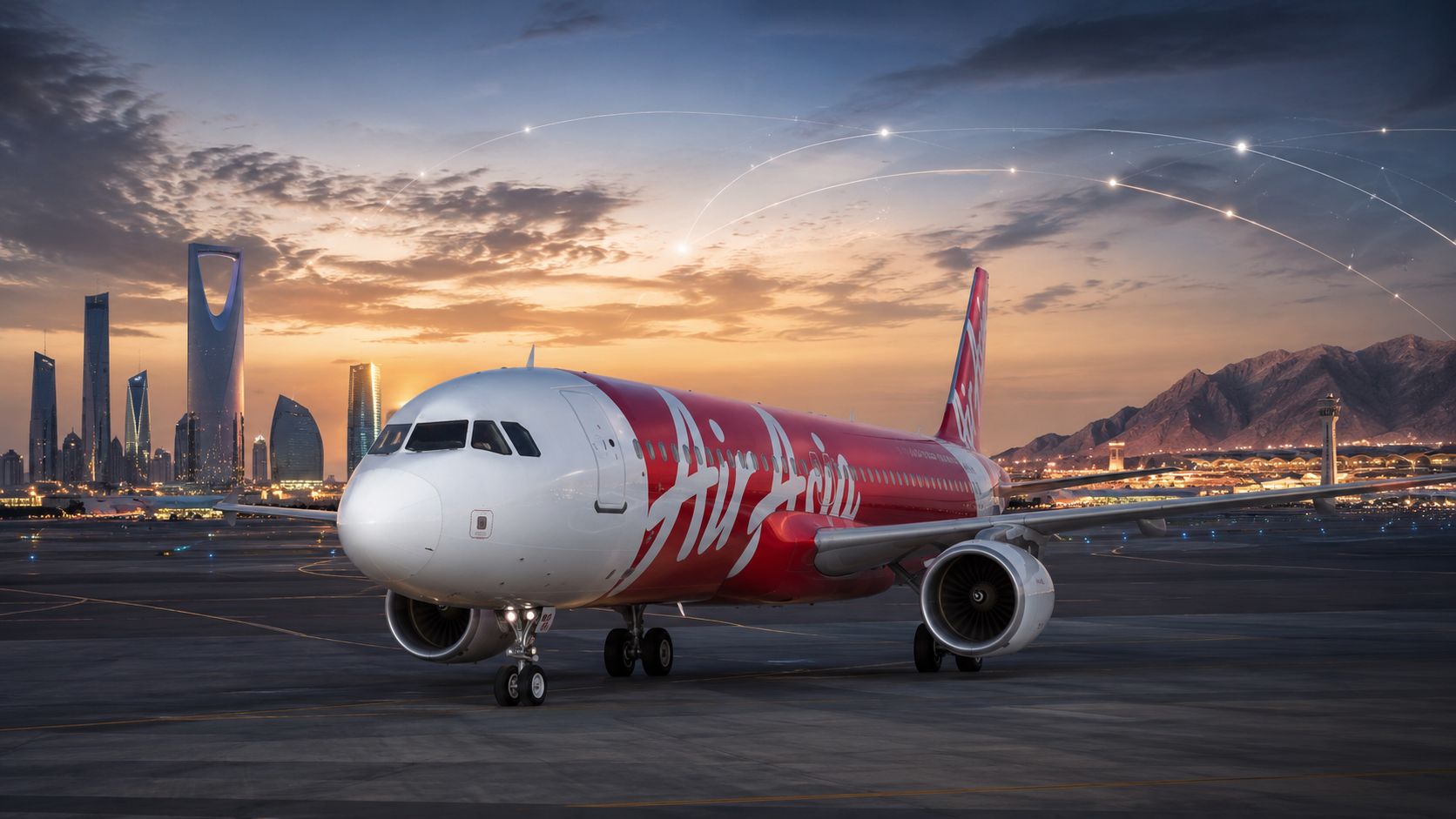
AirAsia’s study of establishing an operations hub in the Gulf — with Ras Al Khaimah and a Saudi destination among the options — is not simply the geographic expansion of an Asian low-cost carrier. It signals a shift in the Gulf’s function within the global aviation map.
Until now, the market has viewed the Gulf as home to full-service carriers such as Emirates, Qatar Airways, and Etihad, or regional low-cost carriers such as flydubai, Air Arabia, and flynas. But the entry of an Asian low-cost player built around an Asia-to-Europe connectivity model via the Gulf could open an entirely new chapter.
Why the Gulf suits low-cost carriers
Geography is the first answer. The Gulf sits at the midpoint between Southeast Asia, Europe, Africa, and the Indian Subcontinent. That advantage built the major Gulf carriers — but it could equally serve a different model: low-cost, cross-regional flying.
The second answer is fleet evolution. Long-range narrowbody aircraft make it possible to operate longer routes at lower cost, opening the door to secondary airports and less congested destinations.
The third answer is demand. Travelers between Asia and Europe are not always seeking a premium experience. Large price-sensitive demand segments exist — particularly among labor migrants, students, young tourists, and family visitors. That is the natural market for carriers like AirAsia.
Ras Al Khaimah as an intriguing case
The inclusion of Ras Al Khaimah among the options is not entirely surprising. The emirate is actively building a distinct tourism identity within the UAE and requires broader air connectivity to support its hotels, resorts, and nature-based experiences.
For AirAsia, Ras Al Khaimah could offer lower operating costs, less congestion than Dubai, and proximity to a large UAE and Gulf market. Yet it would need a strong ground-connectivity and marketing infrastructure to avoid remaining merely an alternative airport.
If the model succeeds, Ras Al Khaimah could become a low-cost gateway for Asian and European demand — rather than depending solely on larger, more congested airports.
Saudi Arabia as a scale opportunity
Saudi Arabia represents a different opportunity altogether. The market is large, domestic demand is strong, religious travel is sustained, and leisure tourism is growing rapidly. AirAsia entering via a Saudi hub could connect the Kingdom to Southeast Asia in a new way — particularly given significant demand from Indonesia, Malaysia, the Philippines, and other Asian markets.
Saudi Arabia is also a competitive market, however. flynas, flyadeal, and regional players are already present. AirAsia’s success will therefore depend not only on price, but on its ability to build a smart connectivity network that does not collide directly with every incumbent.
The impact on airport systems and distribution
Any new low-cost carrier operations hub will create direct pressure on airport systems and distribution infrastructure.
The low-cost model demands high aircraft turnaround speeds, low costs, strong direct sales, ancillary revenue streams, precise seat management, and flexible payment systems. Airports and local platforms must therefore be capable of supporting high-efficiency operations.
AirAsia’s entry will also test the ability of Gulf booking platforms to sell LCC products correctly — bags, seats, meals, changes, and multi-sector connections — a process that is not always straightforward within traditional distribution systems.
Does AirAsia threaten Gulf carriers?
Not necessarily.
AirAsia does not compete with Emirates or Qatar Airways for the same customer in every case. But it may draw away a portion of price-sensitive demand, particularly on routes where passengers do not require a full-service experience.
The greater impact will fall on regional low-cost carriers, and on airports seeking to attract new traffic without relying solely on their national carriers.
The Gulf as a Low-Cost Connecting Hub
If the AirAsia study translates into an actual operating base, we may be witnessing the beginnings of a new model: the Arabian Gulf as a low-cost connecting hub between Asia and Europe.
This does not invalidate the full-service carrier model, but it adds a new layer — one that is more price-sensitive and more reliant on technology and operational efficiency.
The market best positioned to host this model will be the one with a flexible airport, competitive operating costs, and distribution systems capable of handling low-cost yet intercontinental travel.