
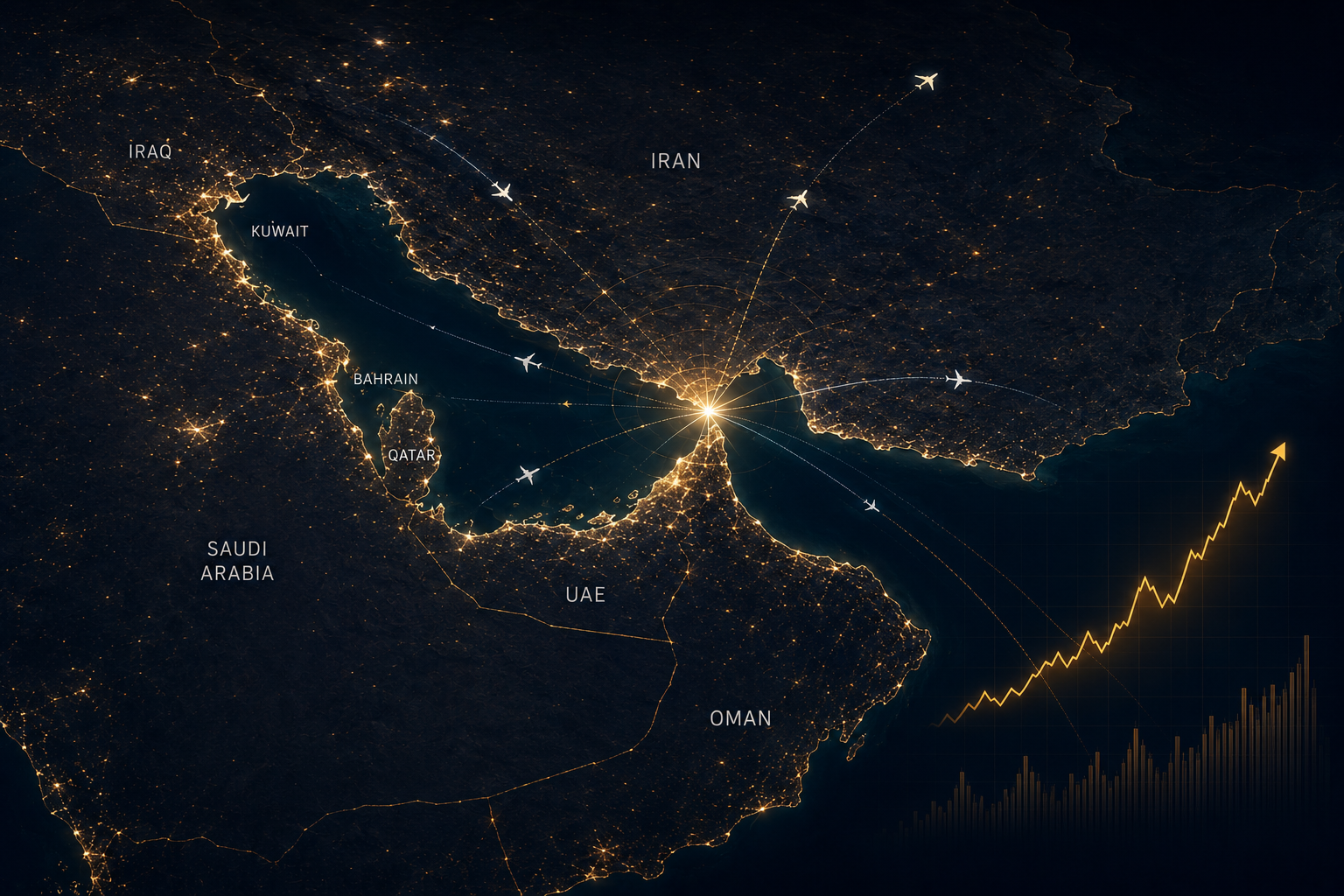
Geopolitical risk is no longer a passing event in the calculus of the Gulf travel sector — it has become a permanent line item in cost structures and decision-making. The hardest challenge for operators and investors is neither open war nor complete peace, but the extended grey zone between them.
On the morning of May 28, Kuwaiti defenses intercepted a ballistic missile — the first strike on a Gulf state since the April ceasefire. Simultaneously, U.S. forces downed drones near the Strait of Hormuz and struck a ground control station in Bandar Abbas. Two days later, the situation remained suspended: Tehran maintains that a ceasefire agreement has not been concluded, amid circulating proposals for a 60-day truce extension that have yet to be resolved.
For every CEO in aviation, hospitality, and travel technology, the message lies not in any single event but in the pattern: the region has entered a phase of “irresolution” in which risk is being repriced across the entire travel value chain. This phase, by virtue of its persistence and ambiguity, is harder to plan around than a sharp, short-term shock.
To grasp the scale, the sequence must be recalled. Since early March 2026, Iranian forces have declared the strait “closed,” threatening and carrying out attacks on vessels attempting to transit, while the United States has enforced a blockade on Iranian ports since April 13. The April 8 ceasefire — brokered by Pakistan — has been violated by both sides since its announcement and extended on multiple occasions.
The economic impact is direct. Approximately 20% of global oil and gas flows pass through Hormuz, and the disruption has triggered the most severe oil market shock in recent memory. At the height of the crisis, more than 800 vessels remained stranded inside the Arabian Gulf as insurers reassessed risk premiums, alongside a proposed transit fee of $2 million per vessel to be shared with Oman. These are not remote logistical details — they are direct inputs into jet fuel costs and insurance premiums.
Meanwhile, the fundamentals remain strong. IATA projects the Middle East will achieve the highest net profit margin globally at 9.3% and the highest profit per passenger at $28.6 in 2026. The tension between strong fundamentals and elevated risk is the core of today’s pricing dilemma.
The risk premium seeps into the sector through three distinct channels — understanding each separately is a prerequisite for managing them.
The first channel — operations and cost. Airspace closures or restrictions impose longer routings, consuming more fuel and extending aircraft cycles. The effect compounds when combined with higher fuel prices and insurance premiums. Here, margins erode quietly, even as demand holds.
The second channel — demand and perception. Travel is more sensitive to perceived security conditions than to actual ones. This is already showing: reports point to declining bookings to Egypt as travelers favor western Mediterranean destinations further from the conflict. The paradox is that a genuinely safe destination can be harmed by the “geography of perception” alone.
The third channel — capital and financing. Prolonged risk raises the cost of capital and extends return horizons, which collides directly with the Gulf’s shift toward private-sector financing models. Additional liquidity pressure comes from the reality that 43% of funds blocked for carriers globally — $515 million — are held in the Middle East and North Africa region.
What is genuinely new, and what is merely expected? What is new is the institutionalization of risk: its transformation from a contingency item managed by exception into a permanent factor embedded in pricing and capital planning. What is expected is the structural resilience of long-term demand. The winner is the operator who manages the former without losing the bet on the latter.
On aviation: operational flexibility — route diversification, fuel hedging, flexible insurance — is shifting from a competitive advantage to a survival requirement. Major hub carriers are better positioned to absorb shocks than smaller carriers already burdened by frozen capital.
On hospitality: the HVS survey assumes conflict containment, warning that any prolonged escalation will materially slow the pace of recovery. The critical threshold is not the security event itself, but the moment owner sentiment shifts from “deferring decisions” to “canceling them.” Monitoring the pipeline matters more than tracking daily occupancy.
On investors: the region rewards those who price risk with precision — not those who ignore it or overcorrect. The best opportunities may lie in cash-generating assets that are geographically insulated, rather than in long-horizon projects exposed to fault lines.
On travel technology: a volatile environment raises demand for disruption-management tools — automated rebooking, dynamic pricing, and flexible distribution systems. This is a direct opportunity for booking platforms, white-label solutions, and API-capable providers that can turn volatility into an operational advantage for their clients.
On government tourism authorities: managing the security narrative has become part of destination management. Countries that draw a clear line between their geographic location and their security reality — as Kuwait did by affirming it is not party to any regional conflict and will not permit its territory to be used to launch an attack — protect their visitor economy from “perception contagion.”
Executive takeaways:
Risk is no longer a contingency item — embed it as a permanent line in pricing and capital planning.
The three channels (operational / demand / capital) require distinct management tools; they cannot be addressed with a single solution.
“Perception geography” can damage a genuinely safe destination — narrative management is part of asset management.
Operational flexibility and hedging are survival requirements for carriers, not luxuries.
Monitor the hotel pipeline, not daily occupancy — deferral before cancellation is the leading indicator.
Outlook:
Over the next 6 to 12 months, the landscape branches into three scenarios. First, a gradual de-escalation: the 60-day ceasefire extension holds and the Strait of Hormuz reopens on a stable footing, causing the risk premium to recede gradually as fundamentals reassert themselves — the most probable scenario given that all parties share an interest in reopening the corridor. Second, prolonged indecision: a persistent “neither war nor peace” state, in which the risk premium becomes a permanent fixture and growth slows without stopping. Third, sustained escalation: this tests the containment assumption underpinning current investment decisions, triggering project deferrals and delayed launch schedules.
The indicators that will determine direction: resolution of the ceasefire extension, the trajectory of insurance premiums, the pace of Hormuz transits, and the stability of launch schedules at Riyadh Air and Gulf Air.
Conclusion:
The economics of indecision reward discipline — not denial, not panic. The winners in the second half of 2026 will be those who price risk with precision, fortify their operations, and simultaneously maintain their conviction in the region’s strong demand fundamentals. Those who read relative calm as the end of risk, or read a single event as the end of the market, are both misreading the moment.