
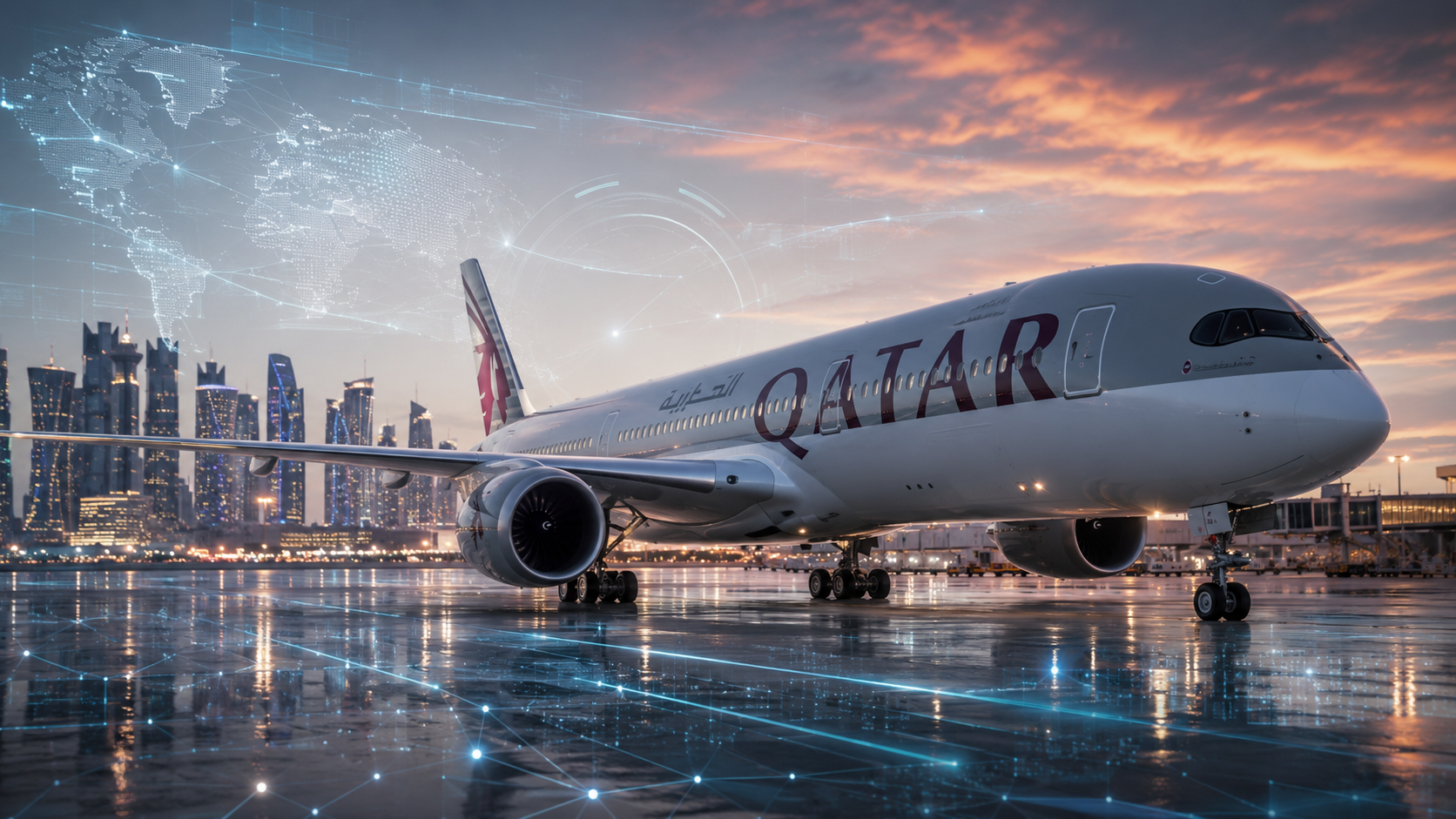
Qatar Airways’ announcement of an AI-powered booking experience through “Sama” should not be read as a technology showcase at a conference. The move represents a deeper shift in the position of Gulf carriers within the travel value chain.
Qatar Airways is moving toward an experience in which travelers can interact — by voice or text — to receive personalized flight suggestions and itineraries. The commercial significance of this move extends well beyond improving user experience. The carrier is not simply selling a seat on a plane. It is attempting to own the planning moment itself.
From Airline to Travel Platform
The major Gulf carriers are no longer pure transport companies. Emirates, Qatar, Etihad, and Saudia all operate complex ecosystems encompassing loyalty, hotels, destinations, entertainment, packages, partnerships, and airport experiences.
Adding an AI travel agent to that ecosystem means the carrier can move closer to the role of a full-service travel platform.
Rather than searching for a flight through an agent, a booking platform, or a comparison engine, the customer can speak directly with the airline’s own AI agent. That agent does not merely sell a flight from Doha to London — it suggests timing, destination, cabin class, a stopover, and perhaps a hotel or experience tied to the loyalty program.
This is where the real competition with distribution intermediaries begins.
Does the AI Agent Threaten Travel Agents?
The answer is not straightforward.
In simple leisure travel, yes — AI agents may reduce customers’ reliance on traditional agents. If a traveler wants a direct flight, a straightforward family holiday, or a price comparison within a specific carrier’s network, the AI agent may well be faster and more persuasive.
In corporate travel, group travel, conferences, complex bookings, and compliance-driven policies, however, travel management companies and business travel agents remain relevant. AI will put pressure on them, but it will not render them obsolete overnight.
The real impact will be felt in margins. Every booking that shifts from an intermediary to a direct channel reduces another party’s commission and deepens the carrier’s relationship with the customer.
The Greater Threat to GDS and OTA
If carrier-owned AI agents mature, the relationship between airlines, GDS platforms, and OTAs may fundamentally change.
Airlines have long sought to grow direct sales and reduce dependence on costly intermediary channels. AI gives them a new instrument to achieve that — not only through lower prices, but through a more personalized planning experience.
Travelers do not always want the cheapest flight. They often want the fastest and clearest decision: fewest stops, best timing, best seat, maximum flexibility, and a reliable experience. If a carrier’s AI agent can deliver that, direct sales stand to become considerably more powerful.
Why Are Gulf Carriers Moving Quickly?
Gulf carriers possess three elements that position them well for this shift: strong brands, extensive databases of traveler behavior, and high-value loyalty programs.
Qatar Airways, for instance, can connect the AI agent to a broader digital experience encompassing its loyalty program, destination data, and seat inventory. Over time, the agent may become capable of delivering increasingly precise recommendations based on a customer’s travel history and preferences.
This does not mean everything is settled. Significant challenges remain: information accuracy, expectation management, data protection, avoiding pricing errors, and ensuring human support when problems arise. But the direction is clear.
What Does This Mean for Travel Companies in the Gulf?
Companies that rely solely on airline ticket resale will face the most pressure. Value will no longer lie in ticket issuance, but in understanding the client’s needs and assembling a complete journey.
Travel management companies that want to survive will need to build their own AI layer — one capable of handling corporate policies, budgets, approvals, invoicing, and reporting.
Traditional agents, meanwhile, will need to shift from booking executors to data-backed travel consultants.
The Future of Gulf Carriers
Qatar Airways’ launch of an AI travel agent is not the end of intermediaries — it is the beginning of a new phase.
Gulf carriers are transitioning from aircraft operators into distribution, experience, and data platforms. And the closer these platforms move to the planning moment, the shorter the distance between them and the end traveler.
The next question is not: will travelers book through AI?
The question is: through whose AI?