In May 2026, as airlines worldwide were discussing aircraft shortages, delayed deliveries, and rising operating costs, Saudi Arabia announced a deal to purchase 105 new aircraft at an estimated value of approximately $19 billion. The figure alone was enough to redirect the industry’s attention toward Riyadh. (Reuters)
But what set the deal apart was not its scale alone — it was its timing.
According to Boeing’s own data, airlines in the Middle East will require more than 3,000 new aircraft by 2042, with passenger traffic in the region expected to double over the next two decades. At a time when certain European markets are slowing, Saudi Arabia is moving in the opposite direction: faster expansion, larger investments, and ambitions that extend well beyond the traditional concept of a “national carrier.” (Boeing Commercial Market Outlook)
This is not an aircraft procurement deal.
It is an attempt to re-engineer the aviation map of the Middle East.
Saudi Arabia Is Not Building an Airline — It Is Building an Entire Transit Economy
For a long time, Saudi Arabia was the largest travel market in the Gulf by domestic demand, yet it was not the region’s most consequential transit hub. That role — and the revenue and influence that came with it — went primarily to Dubai and Doha.
The UAE built its model around global transit traffic, while Qatar leveraged Qatar Airways to construct economic and political influence that far exceeded its geographic size. Saudi Arabia, by contrast, remained historically dependent on religious traffic and domestic demand.
Now, Riyadh appears intent on changing that equation entirely.
Vision 2030 targets raising tourism’s contribution to 10% of GDP and attracting 150 million visits annually by the end of the decade, compared with approximately 27 million international tourists in 2023. (Saudi Vision 2030)
Reaching those numbers, however, requires something more fundamental than hotels and tourism projects:
a large-scale aviation network capable of moving that volume of traffic.
That is what makes the 105-aircraft deal coherent.
Saudi Arabia is not simply adding operational capacity — it is building an entire infrastructure layer:
- New airports
- Fleet expansion
- Broader domestic connectivity
- Growth in low-cost traffic
- Positioning Riyadh as a transit hub between Asia, Europe, and Africa
That is precisely what makes this deal part of an economic project — not merely an operational decision by an airline.
Riyadh Air: The Project That Could Redistribute Gulf Influence
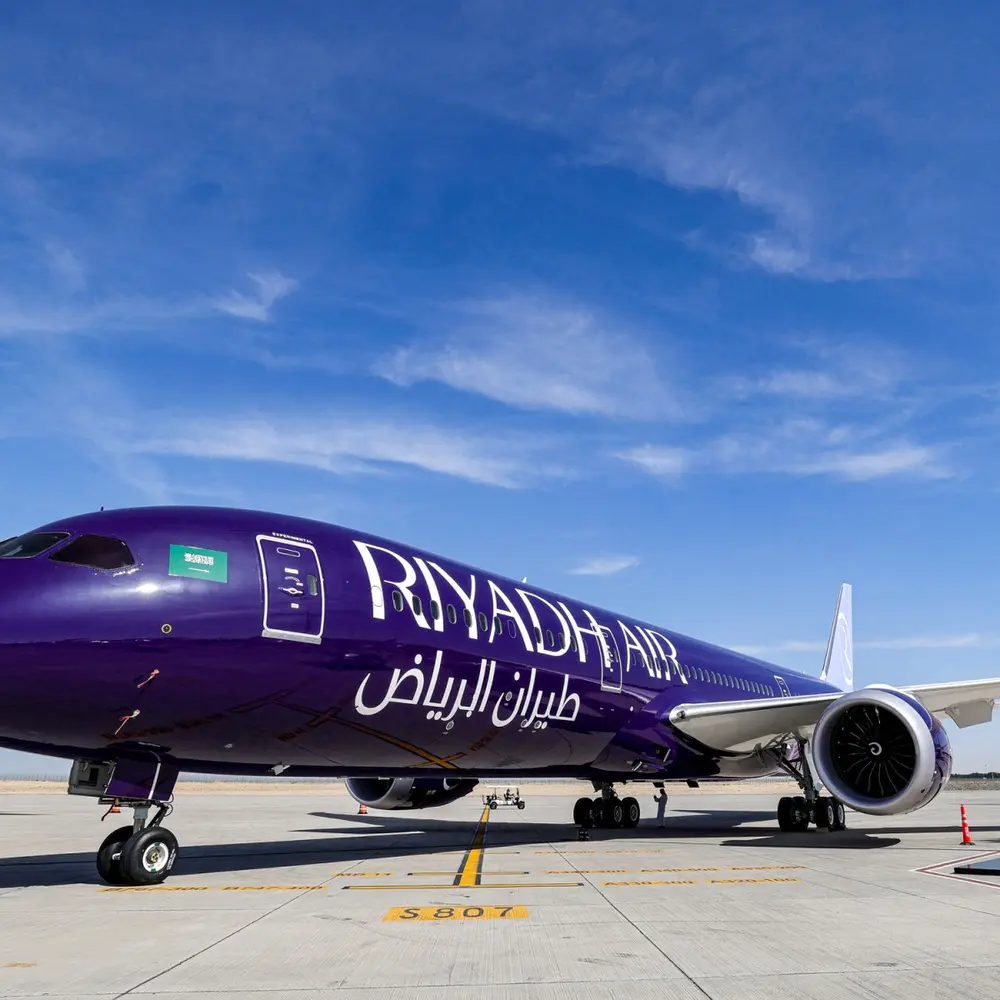
When Saudi Arabia launched Riyadh Air in 2023, many assumed it was simply a Saudi version of Emirates or Qatar Airways. Over the past two years, however, it has become clear that the project is far more expansive than that.
The new carrier, backed by Saudi Arabia’s Public Investment Fund (PIF), is targeting service to more than 100 destinations by 2030, with an expected contribution exceeding $20 billion to non-oil GDP. (Reuters)
But the more consequential question is not the destination count — it is the redistribution of air traffic across the Arabian Gulf.
For two decades, long-haul aviation in the region has revolved around two primary hubs:
- Dubai
- Doha
Riyadh was never a genuine part of that equation.
Today, Saudi Arabia is attempting to establish a “third hub” — one with an economic and demographic base that nearly exceeds its Gulf rivals combined.
This shift has the potential to alter:
- Global transit routes
- Foreign airline strategies
- Air connectivity pricing
- And even the competitive balance among Gulf airports
Notably, the Kingdom is not relying on Riyadh Air alone.
Also in play:
- SAUDIA, undergoing restructuring and conventional network expansion
- flyadeal, driving low-cost growth
- Multi-billion-dollar investment in King Salman International Airport, which Saudi Arabia aims to bring to a capacity of 120 million passengers by 2030 — and 185 million thereafter. (PIF)
In that sense, the Kingdom is not merely launching a new airline — it is redesigning its entire role within the aviation industry.
Why the deal unsettles both Airbus and Boeing
The irony is that the deal widely covered as a “Saudi Boeing order” ultimately benefited Airbus — through a substantial order for the A320neo and A321neo family. (Reuters)
But the significance of the deal extends well beyond the question of who won the contract.
Saudi Arabia has become one of the most strategically important battlegrounds in the global competition between Boeing and Airbus.
In recent years:
- Boeing has faced compounding crises around quality, safety, and supply chains
- Airbus has achieved near-dominance in the narrowbody aircraft market
- Airlines globally are contending with delivery delays and a shortage of new aircraft
Amid that turbulence, Saudi Arabia has emerged as the ideal client.
The Saudi market is not simply buying aircraft — it is buying:
- Maintenance contracts
- Training programs
- Manufacturing partnerships
- Technology programs
- And potentially, future production lines and logistics infrastructure tied to the aerospace sector
This gives Riyadh substantial negotiating leverage with global manufacturers.
It also points to a broader industry shift:
the real center of gravity in global aviation is moving gradually from the West toward the Arabian Gulf, Asia, and India.
The Gulf Enters a Phase of “Competitive Saturation”
For the first time in years, the Gulf no longer appears to be expanding as a single bloc.
The UAE, Qatar, and Saudi Arabia are now effectively competing for:
- The same traveler
- The same transit routes
- The same investments
- And even the same executive talent
The question many executives are now asking:
Can the Gulf absorb this volume of new capacity?
According to IATA, air traffic in the Middle East is projected to grow at an annual rate of approximately 4.4% through 2040 — a strong figure, but one that may not be sufficient on its own to absorb the current expansion wave if the global economy slows or transit traffic declines. (IATA Forecasts)
This opens the door to two scenarios:
- Either the Gulf evolves into the world’s largest multi-hub aviation center
- Or the region enters an intense competitive cycle that compresses profit margins for years
In either case, Saudi Arabia will be the most consequential variable in the equation ahead.
“Saudi Arabia is not entering the Gulf aviation market — it is redefining its scale entirely.”
The Horizon Ahead: Will Riyadh Become a “New Dubai” — or an Entirely Different Model?
The greatest mistake in reading the Saudi project is assuming the Kingdom is simply trying to replicate the UAE or Qatar.
The reality is that Saudi Arabia operates with a different equation:
- A large domestic market
- Sustained religious traffic
- Enormous sovereign spending power
- And tourism projects under development at a scale unprecedented globally
This may allow it to build a model less dependent on pure transit and more anchored in tourism, investment, and domestic demand.
But success will not be measured by the number of aircraft or new airports.
The real test will lie in:
- Operational quality
- Passenger experience
- The ability to achieve profitability
- Building an effective global network
- And sustaining demand in a volatile geopolitical environment
Over the past decade, Dubai and Doha defined the future of Gulf aviation.
Over the decade ahead, Riyadh appears determined to become the new center of gravity for the industry as a whole.
And the latest deal was, in all likelihood, the first clear signal that aerial competition in the Gulf has entered an entirely different phase.