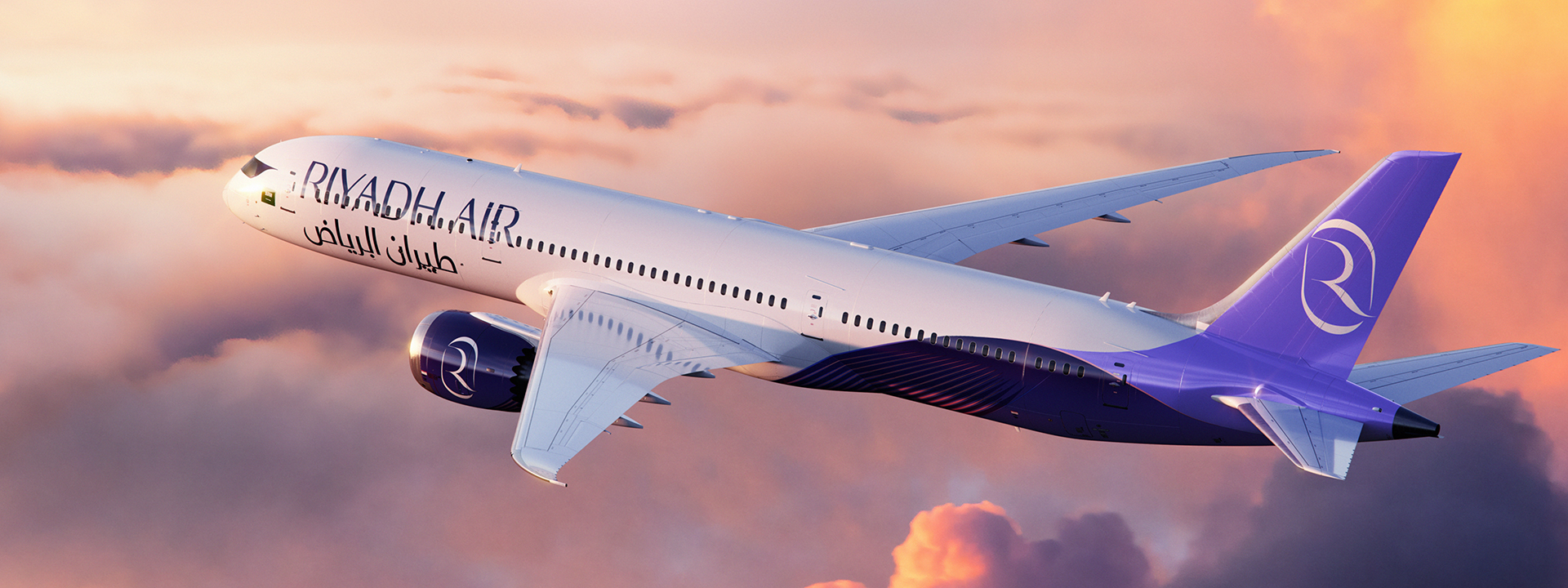
When Riyadh Air first appeared in its gleaming purple livery at the Paris Air Show, the event was not simply a new brand launch.
Within the aviation industry, the reaction was something else entirely: Saudi Arabia was not entering the market as an additional carrier, but as a player intent on redistributing power within the Middle East’s largest aviation market.
That interpretation does not come from marketing campaigns or official statements alone — it comes from the scale of the project itself.
By 2030, Saudi Arabia aims to receive 150 million visits annually, raise tourism’s contribution to 10% of GDP, and transform Riyadh into one of the world’s top ten economic cities. These targets are unachievable without a vast air network capable of connecting the Kingdom to the world with the efficiency Dubai built over the past two decades. (Vision 2030)
For that reason, Riyadh Air looks less like a start-up airline and more like a sovereign infrastructure project.
Building the Fleet: Saudi Arabia Buys Time Before It Buys Aircraft
In March 2023, Riyadh Air announced an order for up to 72 Boeing 787 Dreamliners — 39 firm orders and 33 purchase options. The deal was valued at more than $37 billion at list prices. (Reuters)
What stands out, however, is not the figure itself but the type of aircraft selected.
The 787 is neither a regional nor a low-cost platform — it is a widebody designed for long-haul intercontinental operations.
From the outset, this signals that the airline is not thinking in terms of a domestic market, but as a global transit hub.
Emirates, by comparison, relies primarily on the A380 and Boeing 777, while Qatar Airways has built much of its strength on a mixed Airbus and Boeing fleet.
Riyadh Air chose from the start to concentrate on long-range, fuel-efficient aircraft — a bet on direct connectivity between Riyadh and major world capitals rather than settling for regional reach alone.
But there is another dimension that matters more.
At a time when Boeing and Airbus face severe global delivery bottlenecks, securing this volume of aircraft early gives Saudi Arabia a strategic advantage.
According to Cirium, a widening global gap exists between travel demand and the availability of new aircraft, driven by supply chain and manufacturing constraints. That means whoever locks in aircraft today secures the capacity to grow tomorrow.
In other words:
Riyadh Air is not simply building a fleet — it is reserving its position early in a global market already suffering from a capacity shortage.
Riyadh Does Not Want to Be a Destination Alone — It Wants to Be a Transit Point Between Three Continents
The real challenge for any aviation hub is not the number of routes — it is geography.
Dubai succeeded because it sits at an ideal intersection linking Europe, Asia, and Africa within roughly 8 hours.
Doha built a comparable model with exceptionally high operational efficiency.
The question now is: what does Riyadh offer?
Saudi Arabia is wagering on something relatively distinct:
- A large domestic market
- Stable religious travel flows
- Rapid tourism growth
- And a geographic position that allows a dual network to be built — domestic and international simultaneously
Riyadh Air has yet to announce its full final network, but early indicators point to an initial focus on:
- London
- Paris
- New York
- Dubai
- Cairo
- Mumbai
- Singapore
- Kuala Lumpur
These are not simply high-profile destinations — they are strategic nodes within global business travel and transit flows.
The core proposition is straightforward:
transform Riyadh from a city dependent on outbound travel into one that international traffic passes through.
This connects directly to the King Salman International Airport project, through which Saudi Arabia is targeting capacity of 120 million passengers by 2030, with long-term plans to reach 185 million passengers annually. (PIF)
If achieved, Riyadh would become not merely a regional competitor — but one of the largest aviation hubs in the world.
The challenge is not buying aircraft — it is building loyalty
There is a common misreading of new Gulf aviation ventures:
the assumption that capital alone can produce a world-class airline.
The reality is considerably more complex.
Emirates did not become a global giant through aircraft alone. It built, over decades:
- A consistent passenger experience
- Operational discipline
- A strong brand image
- The trust of the international traveler
The same applies to Qatar Airways.
Riyadh Air, by contrast, is starting from zero.
There is no established customer base.
There is no globally embedded loyalty program.
And there is no positive brand memory for travelers to draw on.
This may be the most difficult challenge the carrier faces.
According to Brand Finance, the Emirates brand became the most valuable among airlines globally in 2024, surpassing $8 billion. Brand equity here is not an aesthetic asset — it is a tangible economic one. (Brand Finance)
Riyadh Air recognizes this, which is why it moved early to invest in:
- Visual identity
- Cabin experience
- Technology partnerships
- Recruiting executives from leading global carriers
But building an aviation reputation takes longer than building airports.
The real test will not be the launch — it will be the years that follow.
“The easiest part of the Riyadh Air project is buying aircraft. The hardest part is persuading the global traveler to change their habits.”
Gulf competition enters an entirely new phase
For two decades, the Gulf aviation equation was relatively stable:
- Dubai as the dominant transit hub
- Doha as a high-quality operator
- Abu Dhabi as a mid-sized player
Riyadh Air may break this equation for the first time.
Not solely because of the scale of investment, but because Saudi Arabia possesses something that was unavailable to its competitors:
- A large population base
- Strong domestic demand
- Stable religious tourism
- Mega tourism projects
- Near-unlimited sovereign spending capacity
Yet this does not mean the path is straightforward.
According to IATA, air traffic in the Middle East is projected to grow at 4.4% annually through 2040 — but the Gulf market is already witnessing a massive expansion race among the region’s largest carriers. (IATA Forecast)
If all carriers expand at the same pace, the region could enter a phase marked by:
- Pricing pressure
- Capacity outpacing demand
- Intensifying competition for transit traffic
- A costly war for talent
In other words, the Gulf could shift from “the world’s greatest aviation success story” to the most competitively expensive market on the planet.
Riyadh Is Testing a Different Model Than Dubai’s — and Perhaps a More Consequential One
A surface reading suggests Saudi Arabia is attempting to replicate the UAE.
A deeper reading points to something different.
Dubai built its economy around aviation.
Saudi Arabia is attempting to use aviation to reshape an entire economy.
Riyadh Air is not a standalone venture — it is part of a broader agenda encompassing:
- Redesigning Riyadh
- Attracting global corporations
- Activating tourism
- Positioning the Kingdom as a regional business hub
For this reason, the airline’s success will not be measured by passenger numbers or profitability alone.
The real test will be:
Can Riyadh genuinely become a city that global traffic moves through — not merely one that travelers arrive at?
If Saudi Arabia achieves this, the coming decade may witness the first genuine redistribution of aviation power in the Gulf since Dubai’s rise in the 1990s.
If the project falters, Riyadh will remain a substantial market — but without the global aviation influence the Kingdom is pursuing today.