In April 2024, Sheikh Mohammed bin Rashid’s announcement of the new expansion at Al Maktoum International Airport was not simply a major infrastructure story. Within the aviation industry, it was read as a declaration marking the end of an entire era in Dubai’s history — and the beginning of a more ambitious, more complex one.
For years, Dubai International Airport seemed an inseparable part of the emirate’s identity. Since 2014, DXB has held its position as the world’s busiest airport for international passengers, surpassing Heathrow, Changi, and Amsterdam Schiphol. The tens of millions who passed through it saw not merely an airport, but a global gateway connecting East and West with unmatched efficiency.
Yet DXB’s very success became part of the problem.
An airport built inside a city expanding at extraordinary speed has gradually reached its natural limits. Its two existing runways operate under intense pressure, and further expansion within the current site has grown increasingly difficult and costly. As Saudi Arabia moves to build King Salman International Airport in Riyadh, and Doha continues to expand Hamad International, Dubai recognised that maintaining its position as the region’s foremost aviation hub could not be achieved by relying on DXB alone.
And so the Al Maktoum Airport project — which began as a long-term concept within Dubai South — returned to the fore as the emirate’s aviation future.
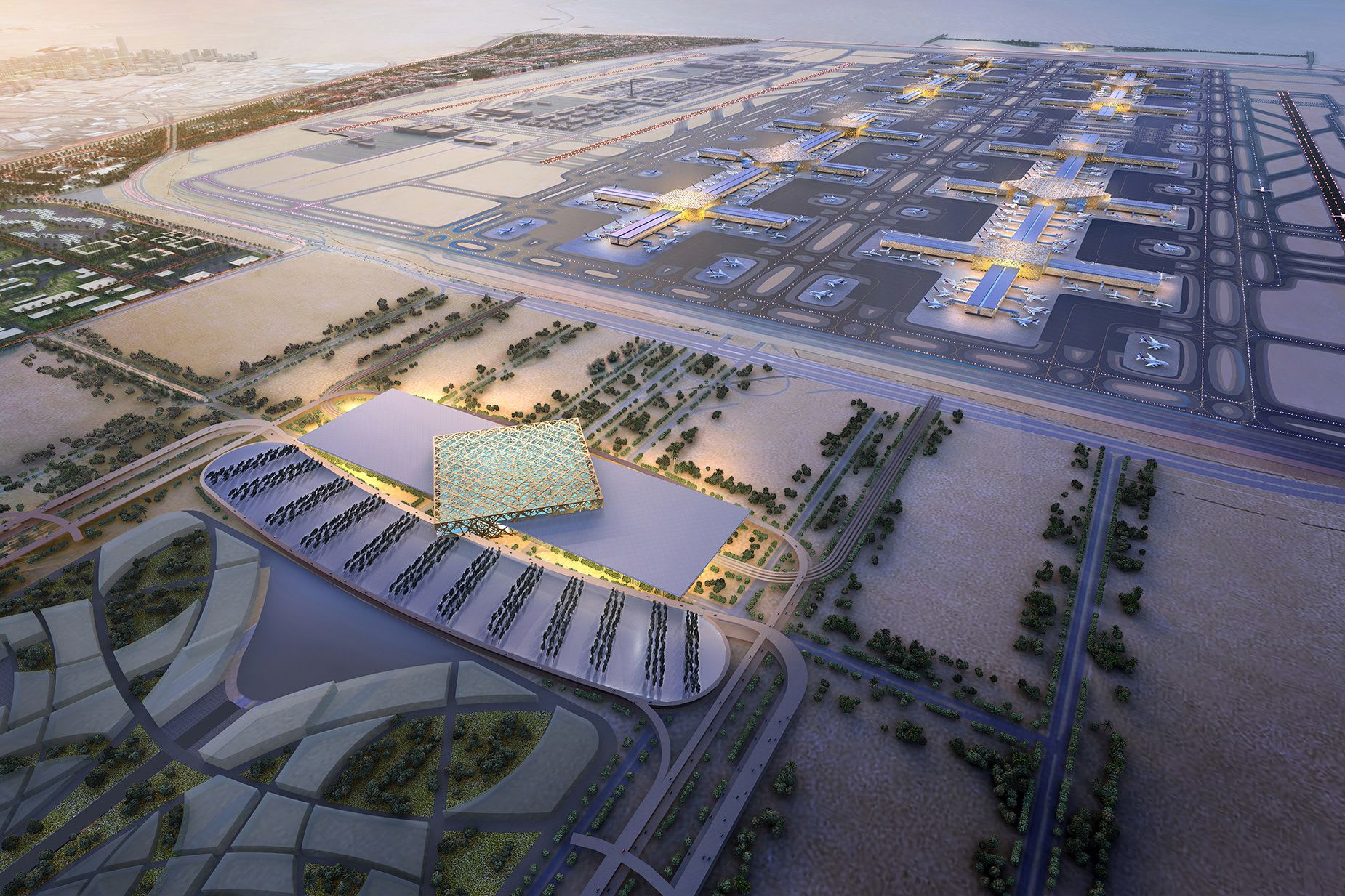
According to official figures, the new project will include five parallel runways and more than 400 aircraft gates, with a target capacity of 260 million passengers annually. If realised, DWC would become the world’s largest airport by a clear margin — and one of the most significant civil aviation infrastructure projects in modern history.
Behind the numbers, however, lies a far deeper bet.
Dubai is not simply building an airport. It is attempting to protect its entire economic model at a moment when Gulf aviation competition is entering a new phase.
A vision conceived early — but its timing now is no coincidence
The idea of Al Maktoum Airport is not a product of 2024. When the airport partially opened in 2010, it was regarded as a long-term contingency project — a future reserve that Dubai might need decades down the line.
But the world changed faster than anticipated.
Following the pandemic, travel demand rebounded with force, while the aviation industry entered a new phase of global competition for major transit hubs. Saudi Arabia launched sweeping projects tied to Vision 2030, and Riyadh has begun speaking openly about building a global aviation hub to rival Dubai and Doha. Meanwhile, Abu Dhabi is investing heavily in the new Zayed International Airport, while Qatar continues to reinforce Hamad International’s standing among the world’s leading airports.
Against this backdrop, incremental expansion clearly no longer sufficed.
The shift toward DWC is directly tied to Dubai’s D33 economic agenda, which targets doubling the emirate’s economy over the next decade and positioning it among the world’s top three economic cities. That cannot be achieved without an aviation infrastructure capable of absorbing sustained long-term growth across:
- Tourism
- Trade
- Business
- And logistics
More fundamentally, Dubai is wagering that the global hub model will remain a decisive factor in the international economy well beyond 2030 — despite all the geopolitical and technological shifts underway.
That, in itself, is a substantial bet.
“Dubai is not merely relocating its airport… it is shifting its economic center of gravity toward the next phase of globalization.”
128 Billion Dirhams to Buy the Future
In the world of airports, operational capacity can be purchased with capital. But what Dubai is attempting to buy here is something far more complex: the ability to expand for decades without constraint.
DXB, despite its success, has become hemmed in by an urban fabric that is nearly complete. DWC, by contrast, sits within a vast footprint that allows for the construction of an integrated aviation, logistics, and residential ecosystem.
For this reason, the project cannot be read simply as “a larger airport.”
Dubai South itself is being developed as a full economic city, with aviation as its primary engine. Roads, metro lines, residential districts, logistics infrastructure, and commercial space are all being built around the premise that southern Dubai will, within the next decade, become an economic center parallel to the city’s existing core.
The relevant comparison here is not a conventional airport like Heathrow, but rather the large-scale projects that have reshaped entire cities.
In Singapore, Changi became part of the nation’s economic identity. In Istanbul, the new airport entirely redirected Turkish aviation’s center of gravity. Dubai is attempting a more ambitious version of both models simultaneously.
But the question remains: will global demand continue growing at the same pace at which Dubai is building?
That is precisely what makes this project closer to a long-term strategic bet than a direct response to an immediate operational need.
What Will Happen to DXB?
Perhaps no question is more sensitive within Dubai today than the fate of Dubai International Airport once the transition is complete.
The land DXB occupies — roughly 30 square kilometers at the heart of the city — ranks among the most strategically and commercially valuable sites in the emirate. No final plan for its future has been announced, yet within real estate and economic circles, sweeping scenarios are already circulating about what the area could become.
History offers comparable precedents:
Kai Tak in Hong Kong was transformed into a major urban development project; Hellinikon in Athens became one of Europe’s largest real estate developments; and the Stapleton site in Denver was redesigned as a complete mixed-use community.
The DXB case is different, however, because the airport is not on the outskirts of the city — it is, for all practical purposes, within it.
That gives Dubai a rare opportunity to reshape an entire section of its urban fabric over the coming decade.
Emirates Faces the Most Complex Operational Transition in Its History
If building DWC is an engineering challenge, relocating Emirates to it will be an unprecedented operational one.
What the airline is preparing for is not simply a change of operational base, but a full reconstruction of its operational network:
maintenance systems, crew management, ground operations, logistics, baggage flows, and the connectivity of transit itineraries.
Any minor disruption to the hub model will immediately reverberate through the experience of millions of passengers.
Yet within that challenge lies a substantial opportunity as well.
For the first time in decades, Emirates will be able to redesign the end-to-end travel experience around a modern infrastructure built specifically for its operational model. This coincides with a transitional phase within the fleet itself — with the A350 entering service, the B777X still awaited, and a gradual future retirement of certain A380 aircraft on the horizon.
In other words, the airline will rebuild part of its entire air model at the very moment it transitions to a new airport.
The Gulf Enters the Era of “Mega Airports”
For much of the past decade, Dubai moved with a comfortable lead over the rest of the region. Today, the picture looks markedly different.
Riyadh is building King Salman International Airport as part of a broader project to transform the Saudi capital into a new global hub. Doha continues to reinforce Hamad International Airport’s position, and Abu Dhabi has officially entered a new phase with Zayed International Airport.
For the first time, the Gulf no longer appears to be merely a region of strong airports — it is a region of direct competition between global mega-hub projects.
This raises a critical question for the global aviation industry:
Can the region absorb this enormous volume of new capacity?
According to IATA and ACI data, travel flows between Asia, Europe, and Africa continue to afford the Gulf a geographic advantage that is difficult to replicate. However, the model itself may face future pressure tied to:
- Environmental sustainability
- Shifting travel patterns
- Long-haul aircraft capable of reducing the need for transit connections
Nevertheless, Dubai appears to be betting that scale, efficiency, and global connectivity will remain decisive factors for decades to come.
What Could Go Wrong?
Mega projects rarely unfold exactly as planned.
A full transfer from DXB to DWC requires:
new metro networks, wider road corridors, residential zones for tens of thousands of employees, large-scale workforce training, and the reallocation of more than 100 airlines currently operating in Dubai.
Then there is the more delicate challenge: timing.
A complete transition by 2032 appears theoretically feasible, but is highly complex in practice. The more realistic scenario within the industry may be a gradual delay of two to three years, particularly given the project’s scale and interdependencies.
Yet even against these risks, the strategic message is unambiguous:
Dubai does not merely want to preserve its current position — it wants to secure it before the global aviation map shifts entirely.
In a world where Saudi Arabia is moving fast and the region is redefining itself economically, Dubai may well conclude that the greater risk is not building a mega airport — but waiting too long.
Sources cited in this article:
- Dubai Airports
- Emirates Group
- IATA
- ACI World
- Reuters
- Bloomberg
- Financial Times
- CAPA – Centre for Aviation
- Cirium
- Arabian Business
- The National (UAE)
- Gulf News
- Dubai Media Office
- WAM