Not all Gulf carriers are racing for scale anymore — some have started chasing profitability
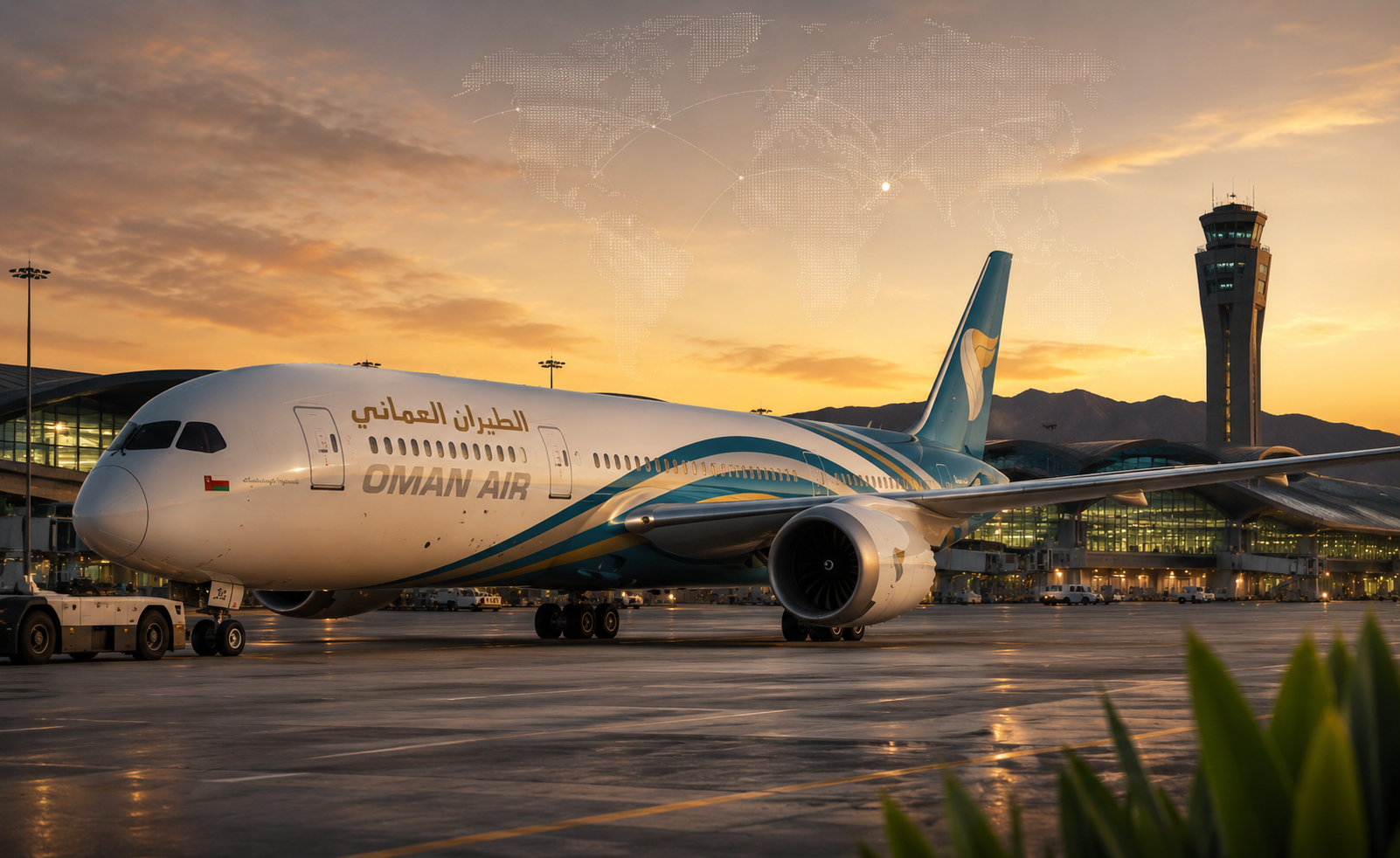
While the major Gulf carriers press ahead with global expansion, adding dozens of aircraft and new destinations, Oman Air appears to be moving in a different direction.
The airline’s announcement that it is considering a new aircraft order comes after years of restructuring and business model reassessment — a move that may reflect less a desire for conventional growth than an attempt to build a more efficient, profitable, and sustainable carrier.
The question today is not how many aircraft Oman Air will order, but why now — and what this move signals about the future of mid-sized Gulf carriers.
From the capacity race to the yield race
Over the past decade, Gulf aviation was shaped by a philosophy built on continuous growth.
More aircraft.
More destinations.
More seats.
But that model was not always profitable.
As operating costs rose, fuel prices fluctuated, and regional competition intensified, many airlines began questioning whether growth alone was sufficient for success.
Oman Air today appears to be among the first Gulf carriers to embrace a different concept: disciplined growth.
In practical terms, that means expanding only when it is profitable to do so — not simply to increase scale or market share.
Why is the airline considering a new order?
Three principal factors are driving Oman Air to consider modernizing or expanding its fleet.
The first is operational efficiency.
Next-generation aircraft offer lower fuel consumption and reduced operating costs, with a direct impact on cost per seat.
The second is flexibility.
Long-range narrowbody aircraft now make it possible to serve routes that previously required larger, more expensive widebodies.
The third is yield improvement.
The airline is not simply seeking to carry more passengers — it is looking to operate its network in a way that maximizes profitability per flight.
Can Oman Air compete with the giants?
The reality is that Oman Air does not need to compete with Emirates, Qatar Airways, or even Riyadh Air on scale.
Those carriers operate under different models, backed by larger markets and far greater capital commitments.
Oman Air’s real value may lie in its ability to occupy a distinct position within the market.
A mid-sized carrier.
A focused network.
A more efficient fleet.
Lower operating costs.
And higher profitability per seat.
This model resembles what we see among successful European and Asian carriers that chose to concentrate on yield rather than pursue headline numbers.
What does this mean for the Gulf aviation market?
If Oman Air succeeds with this strategy, we may witness a broader shift across the region.
Rather than measuring airline success solely by aircraft count or destination breadth, investors and regulators may begin focusing on other indicators:
- Revenue per Available Seat (RASK)
- Cost per Available Seat (CASK)
- Operating profitability
- Fleet efficiency
- Load factor
These are metrics that have grown more critical than ever in an industry facing mounting margin pressure.
Challenges Remain
Despite the positive indicators, Oman Air continues to operate in a highly competitive environment.
The region is seeing new entrants such as Riyadh Air, alongside the continued expansion of the major Gulf carriers.
Geopolitical tensions and fluctuations in global demand could also weigh on expansion decisions in the years ahead.
The success of any new order will therefore depend not only on the aircraft type, but on the airline’s ability to deploy them within a network that generates sustainable returns.
Voyara’s View
Oman Air’s signal that it is studying a new aircraft order may appear to be a routine operational development.
In reality, it points to a deeper shift within the Gulf aviation industry.
After years in which success was measured by scale, some carriers appear to be focusing on something more fundamental: profitability.
In a world of rising costs and intensifying competition, the winner may not be the carrier with the largest fleet, but the one that generates the highest return from every aircraft, every seat, and every flight.
Oman Air may be among the first Gulf carriers attempting to prove exactly that.